In the past, researchers studied readability enhancement of English articles for non-native
English readers, either on paper reading or hypertext reading. Using a variety of methods,
researchers were able to enhance the reading comprehension and the users' satisfaction on
hypertext reading, such as changing content presentation with visual-syntactic text
formatting (VSTF) format or Jenga format. In terms of dynamically changing content
presentation for reading, one less explored format is Portable Document Format (PDF), which
was traditionally viewed within a modern Web browser or Adobe Acrobat reader on the desktop.
PDF format was standardized as an open format in 2008 and has been widely used to keep a
fixed-layout content. However, a fixed layout document presents a challenge to apply
existing transformation methods, not mention on mobile devices. In this paper, we present a
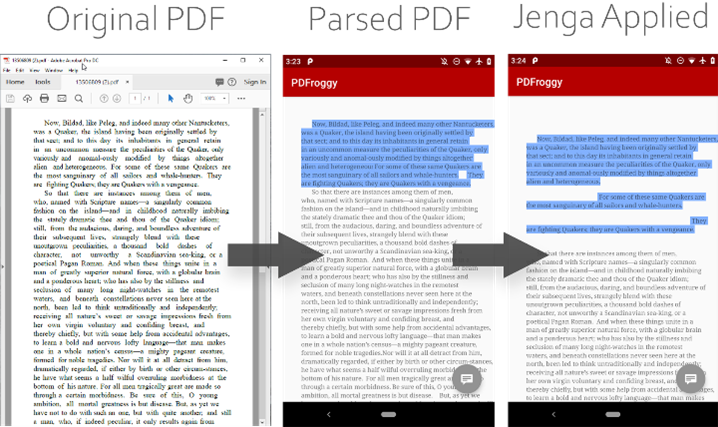
system that uses a novel algorithm to decode a PDF document and apply content transformation
to enhance its readability. Although we used Jenga format as an example to enhance the
readability of PDF documents, we envision the proposed framework can be used to adopt
different transformation methods. The system was implemented in a mobile device and we are
able to apply a basic transformation to a PDF document at both the sentence and paragraph
levels. The main contribution of this research is we extend previous work of readability
enhancement from paper document and hypertext content to PDF documents. Current result is
promising, and we believe it is worth further investigation to make PDF documents readable
and accessible on the Web for different populations, such as non-native English readers,
people with dyslexia or special needs, etc.